
Note Spotter
One of the biggest obstacle for music students is the ability to read notes quickly. For many learners, especially beginners, notes are kind of a mystery. Not enough emphasis is laid on spotting those notes with adequate precision and velocity. To some degree, it’s like trying to read texts without knowing the alphabet.
Here the Note Spotter Project comes into action. It is a simple program with the regular use of flash cards, computer apps and other aids. By using a control system students learn to spot notes on a step by step basis. While common mnemonics can be used in the beginning phase, direct spotting is trained systematically and is the actual key ingredient of the program.
 Note Spotting con be done in various ways. You can use the Note Finder Modules on the right side bar or utilize Flash Cards. In both cases it is important to measure relative progress. Mnemonics (helper sentences) can be used first as an aid. Afterwards, direct spotting is necessary to achieve the necessary speed.
Note Spotting is best done in short sessions of about 10 minutes per day. Significant results will appear after a few months if the spotting is done the regularly and diligently. While the action should be playful, it is important to allow for measurable quantification. This can be done by using a stop watch or metronome. It is also important to record progress using a statistics table.
After the first phase of spotting where mnemonics are used, the result will be between 10 to 20 flash cards per minute. By using direct spotting the speed can easily increase to 30 – 40 cards per minute. 40 will be the first target and then going up to 60 and 80. Parental support or co-operation with a sibling is a good way to increase efficiency.
Mnemonics
Note Spotters in Action


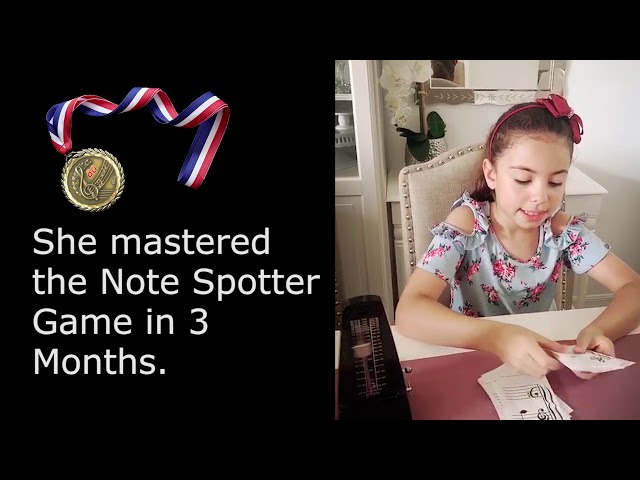


Using Flash Cards

 The Hall Leonard Flash cards come in 3 different colors: white, pink, and yellow. For our Note Spotter drills, we use the white cards. The other cards can also be used for other training purposes, such as rhythmic training an musical symbols recognition.
The cards can be used solo or with another coach, such as a fellow student or parent. All cards are two sided. On the font side is the respective note on the grand staff, either with or without ledger lines. Ledger lines are auxiliary dashes below or above the staves. The flip side carries an explanation of how the note is called and shows its relative position on the keyboard.
During the First Stage, notes should be learned by using the mnemonic helper phrases. A Coach should be present for the drill. Cards with ledger lines should not be used for the first spotting. Student is shown the front side of the card. He then has to apply the mnemonic phrases to determine the note.
In the course of the Second Stage the cards with ledger lines should be included. Otherwise, everything is the same as above.
The Third Stage is learning the notes without mnemonic help. This can be achieved by using two piles. One where the spotting was successful and the other where the spotting failed. Then the failed cards should be learned and again be divided an a passed and flunked pile. This is done until only a p0assed pile is left.
Entering the Fourth Stage a stop watch is required. Now student has to check how many cards he can correctly spot in one minute. If a coach is available, he can verify the answers of the student. If the student is alone, he can flip the cards to see if his response is correct or false. This drill should be done until the student can spot 40 cards per minute.
Stage Five is done with a metronome. Student sets metronome from 40 BPM gradually up to 80 BPM. Each metronome beat requires a note spotting. The drill is ended when the student can easily spot 80 notes per minute.
Measuring the Success

Note Spotting is the first step for acquiring elevated sight reading skills. After the 80 cards per minute spotting, additional exercises are required to transfer the known notes quickly to the keyboard. Those drills are covered in another chapter. However, experience has shown that students with good spotter results subsequently become excellent sight readers.
Sight Reading is an extremely valuable skill for musicians to have. Without the ability to sight read fluently, musicians are limited to playing music they can play by ear or else have memorized. To develop your skills, focused practice is necessary. In another chapter, we’ll take an in-depth look at how to build your sight reading ability. Stay tuned for more information about sight-reading.